
Table of Contents
Introduction
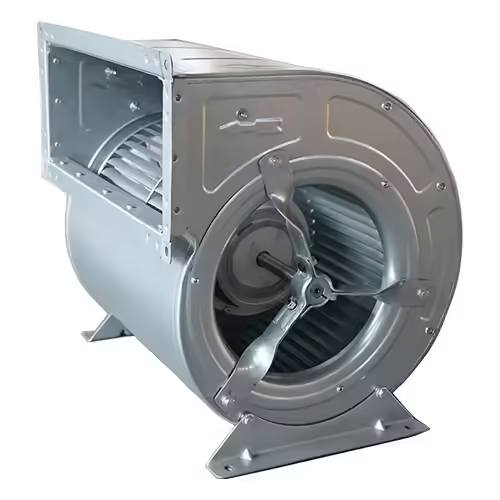
Noise control is becoming increasingly important in modern ventilation systems. For office buildings, medical facilities, residential environments, and precision manufacturing, quiet operation is not just a preference—it’s a requirement. As a professional centrifugal fan manufacturer, offering a silent centrifugal fan provides customers with powerful performance without noise disturbance. This article explores design features, benefits, applications, and selection tips for noise-optimized centrifugal fans.
What Makes a Silent Centrifugal Fan Different?
A silent centrifugal fan is engineered specifically to minimize noise while maintaining strong airflow and pressure. The reduction in noise is achieved through a combination of aerodynamic optimization, sound-absorbing materials, precision balancing, and vibration-reducing structures.
Key enhancements include:
- Smooth blade geometry
- Low-turbulence airflow channels
- Quiet motor technology
- Reinforced vibration isolation
- High-precision dynamic balancing
These elements work together to produce a quiet yet powerful ventilation solution.
Core Features of a Silent Centrifugal Fan
Optimized Blade Airflow
The impeller blades are designed to reduce turbulence and air friction, directly lowering noise levels.
Low-Noise Motor System
High-efficiency motors with improved winding and insulation significantly minimize humming or buzzing.
Vibration-Damping Housing
Rubber mounts, reinforced brackets, and isolated bases absorb vibration generated during operation.
Sound-Reducing Air Duct Design
Air paths are engineered to prevent whistling, airflow shocks, and resistance buildup.
Precision Manufacturing
Tighter tolerances ensure smooth, consistent rotation—which is essential for quiet performance.
Advantages of Silent Centrifugal Fans
Whisper-Quiet Operation
Ideal for noise-sensitive environments such as hospitals, libraries, and residential ventilation.
High Energy Efficiency
Aerodynamic improvements reduce power consumption while maintaining strong airflow.
Enhanced Comfort
A quiet ventilation system creates a more comfortable working and living environment.
Stable Long-Term Performance
Reduced vibration and wear extend the lifespan of the fan and connected equipment.
Suitability for Any Installation
Low-noise centrifugal fans can be installed in compact, enclosed, or sound-critical spaces.
Applications of Silent Centrifugal Fans
Silent centrifugal fans are widely used where airflow performance and low noise must coexist:
- Office HVAC systems
- Laboratory ventilation
- Hospital and clinic air systems
- Residential exhaust and purification units
- Data center cooling
- Clean rooms and electronics factories
- Sound-sensitive industrial environments
- Hotel and commercial building ventilation
Comparison Table: Standard vs. Silent Centrifugal Fan
| Feature | Standard Centrifugal Fan | Silent Centrifugal Fan |
|---|---|---|
| Noise Level | Medium–High | Low–Ultra Low |
| Impeller Design | Basic geometry | Aerodynamic low-noise design |
| Vibration | Moderate | Strongly reduced |
| Motor Type | Standard | Quiet high-efficiency motor |
| Best Use | Industrial ventilation | Noise-sensitive environments |
How to Choose the Right Silent Centrifugal Fan
To ensure perfect performance, consider the following:
- Required airflow (CFM or m³/h)
- Static pressure needed
- Maximum acceptable noise level (dB)
- Installation space constraints
- Material durability needs
- Power supply requirements
- Custom mounting or ducting options
Selecting a model that matches your system ensures both quiet operation and strong airflow efficiency.
Maintenance Tips for Keeping Noise Low
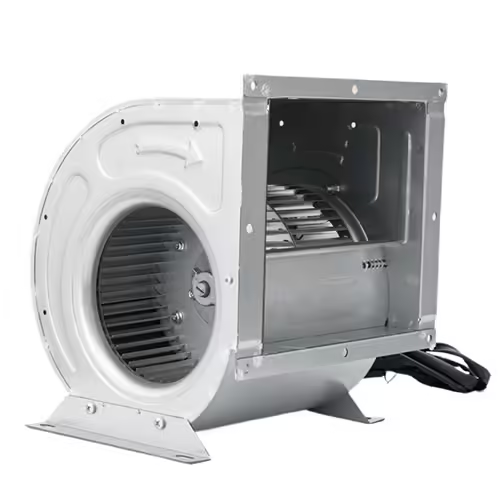
Even a silent centrifugal fan requires proper maintenance to stay quiet:
- Clean blades to prevent dust imbalance
- Tighten bolts and check mounting stability
- Lubricate bearings regularly
- Replace worn vibration pads
- Inspect ducts for blockages or airflow noise
- Keep filters clean to reduce airflow resistance
Routine care ensures long-term low-noise operation.
Conclusion
A silent centrifugal fan is the ideal ventilation solution for environments where noise must be controlled without sacrificing performance. With advanced aerodynamic design, high-efficiency motors, and improved vibration reduction, these fans offer powerful airflow with minimal sound. As a manufacturer, delivering silent centrifugal fans enhances your product line, meets growing market needs, and boosts customer satisfaction across multiple industries.
FAQ
What is a silent centrifugal fan?
A silent centrifugal fan is a noise-optimized fan designed to deliver strong airflow with minimal sound, using advanced blade design, quiet motors, and vibration-reducing structures.
How quiet can a silent centrifugal fan be?
Most silent centrifugal fans operate between 35–55 dB depending on size and airflow demand, making them suitable for hospitals, offices, and residential spaces.
What applications require a silent centrifugal fan?
They are ideal for HVAC systems, clean rooms, laboratories, medical facilities, hotels, data centers, and other noise-sensitive environments.
How do silent centrifugal fans reduce noise?
They use aerodynamic blades, balanced impellers, low-vibration housings, quiet motors, and optimized air channels to minimize turbulence and mechanical noise.
Do silent centrifugal fans require special maintenance?
Maintenance is simple—regular cleaning, bearing lubrication, checking mounts, and replacing worn vibration pads help keep the fan operating quietly long-term.