
Table of Contents
What Is an Industrial Centrifugal Blower?
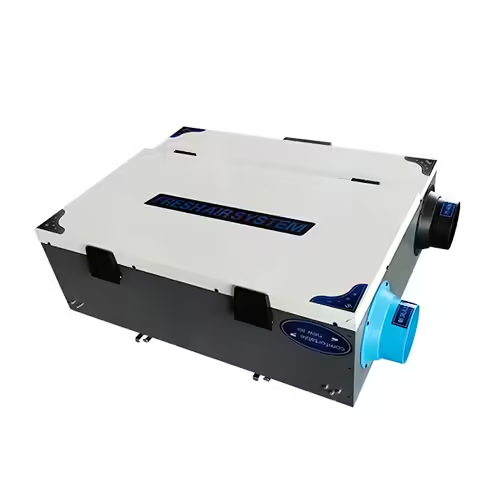
An industrial centrifugal blower is a high-performance fan designed to move large volumes of air or gas under moderate to high pressure. Unlike standard fans, centrifugal blowers draw air into a central inlet and expel it radially, enabling consistent airflow even in complex duct systems.
These blowers are widely used in industrial environments due to their robust construction, high efficiency, and adaptability. They are essential for ventilation, cooling, dust extraction, and material handling systems in manufacturing plants and commercial facilities.
Key Benefits of Industrial Centrifugal Blowers
Industrial centrifugal blowers provide several operational advantages:
- High Airflow and Pressure – Maintains consistent performance in long duct runs or high-resistance systems.
- Durable Construction – Built to withstand dust, heat, moisture, and continuous operation.
- Energy Efficiency – Optimized impellers and motors reduce electricity consumption while delivering maximum performance.
- Versatility – Suitable for HVAC, dust collection, chemical fumes, cooling, drying, and combustion air supply.
- Easy Integration – Compatible with existing ductwork and ventilation systems.
Example: A factory replacing a standard fan with an industrial centrifugal blower improved airflow efficiency by 25% while reducing maintenance costs.
Applications of Industrial Centrifugal Blowers
Industrial centrifugal blowers are highly versatile and used in:
- Manufacturing Plants – Ventilation, dust extraction, and material handling.
- HVAC Systems – Large-scale heating, cooling, and air distribution.
- Chemical and Pharmaceutical Facilities – Safe exhaust of fumes and gases.
- Food and Beverage Processing – Cooling, drying, and cleanroom air circulation.
- Power Plants and Energy Facilities – Flue gas handling, air supply, and cooling.
Their robust design ensures reliable operation even in harsh and demanding industrial environments.
Key Features of High-Quality Industrial Centrifugal Blowers
When choosing an industrial centrifugal blower, look for these features:
- Impeller Design – Forward-curved, backward-curved, or radial blades for maximum efficiency.
- Motor Options – High-efficiency, variable speed, or explosion-proof motors for specific industrial requirements.
- Housing and Material – Heavy-duty steel, corrosion-resistant coatings, or stainless steel depending on application.
- Noise and Vibration Control – Precision balancing and acoustic designs to reduce operational noise.
- Maintenance-Friendly Design – Easily accessible bearings, filters, and impellers for minimal downtime.
These features ensure a blower that is powerful, durable, and energy-efficient.
How to Choose the Right Industrial Centrifugal Blower
Consider the following factors when selecting a blower for industrial applications:
- Airflow Requirements (CFM / m³/h) – Match system demand for ventilation or exhaust.
- Static Pressure (Pa) – Ensure the blower can overcome ductwork resistance.
- Operating Environment – High temperatures, humidity, dust, or corrosive gases.
- Motor Type and Voltage – Must suit facility power supply and efficiency requirements.
- Noise Limitations – Especially for indoor or semi-enclosed environments.
- Customization Needs – Tailored impellers, housing materials, or mounting options.
Proper selection ensures maximum performance, energy efficiency, and long-term reliability.
Industrial Centrifugal Blower vs Standard Fans
| Feature | Standard Fan | Industrial Centrifugal Blower |
|---|---|---|
| Airflow Capacity | Low to Medium | High |
| Pressure Handling | Low | Medium to High |
| Durability | Moderate | High, built for industrial use |
| Energy Efficiency | Standard | Optimized |
| Noise Level | Higher | Moderate to Low with precision design |
Industrial centrifugal blowers outperform standard fans in industrial-scale airflow, pressure handling, and long-term reliability.
Manufacturing Expertise and Custom Solutions
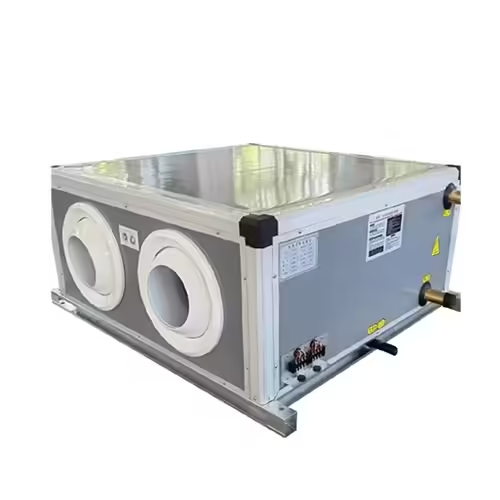
As a manufacturer, we provide industrial centrifugal blowers with:
- High-quality materials and robust construction
- Custom airflow, pressure, and motor options
- OEM and bulk supply capabilities
- Technical support for installation and system design
Our solutions ensure reliable, high-performance airflow systems for factories, commercial facilities, and industrial operations.
Conclusion
Industrial centrifugal blowers are essential for modern manufacturing, HVAC, and industrial air handling systems. They deliver high airflow, durability, and energy efficiency, meeting the demands of challenging environments.
Need help choosing the right industrial centrifugal blower for your system? Contact us today for expert guidance and a customized solution that ensures reliable, efficient, and long-lasting ventilation.
FAQ
Q1: What is an industrial centrifugal blower?
A: It is a high-performance fan designed to move large volumes of air or gas under moderate to high pressure, commonly used in industrial and commercial ventilation systems.
Q2: What are the main applications of industrial centrifugal blowers?
A: Typical applications include manufacturing plants, HVAC systems, dust collection, chemical and pharmaceutical facilities, and cooling or drying processes.
Q3: How does an industrial centrifugal blower differ from a standard fan?
A: Industrial centrifugal blowers can handle higher airflow and pressure, are more durable, and maintain consistent performance in long duct systems compared to standard fans.
Q4: What should I consider when choosing an industrial centrifugal blower?
A: Key factors include airflow (CFM), static pressure (Pa), operating environment, motor type and efficiency, noise level, and maintenance requirements.
Q5: Can industrial centrifugal blowers be customized?
A: Yes. Manufacturers can provide custom impeller designs, housing materials, motor options, and performance specifications to meet specific industrial needs.