
Table of Contents
Introduction: Why Heavy Duty Matters
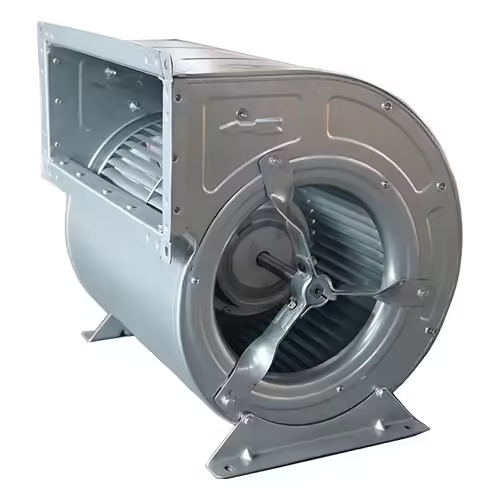
In heavy industrial environments, airflow equipment must withstand high loads, harsh conditions, and continuous operation. A heavy duty centrifugal blower is specifically engineered to handle these challenges, providing reliable, high-capacity airflow while minimizing downtime and maintenance costs.
Unlike standard centrifugal blowers, heavy duty models are designed for large-scale ventilation, industrial exhaust, cooling, and process air applications, ensuring maximum operational efficiency and safety.
Core Benefits of Heavy Duty Centrifugal Blowers
- High Load Handling:
- Designed to operate under high pressure and volume requirements.
- Ideal for environments such as chemical plants, foundries, and mining operations.
- Extended Operational Life:
- Built with reinforced impellers, industrial-grade motors, and corrosion-resistant materials.
- Can operate for thousands of hours with minimal wear.
- Consistent and Powerful Airflow:
- Maintains stable airflow even under fluctuating load conditions.
- Prevents production delays caused by insufficient ventilation or exhaust.
- Maintenance Efficiency:
- Modular design allows for quick access to bearings, impellers, and motor components.
- Reduces labor time and equipment downtime.
- Energy Efficiency for Heavy Applications:
- Optimized motor and impeller design reduces electricity consumption despite heavy-duty operation.
- Compatible with variable frequency drives (VFD) for dynamic airflow control.
Design Features of Heavy Duty Centrifugal Blowers
- Reinforced Impellers: Handle large volumes and resist deformation under high pressure.
- Robust Housing: Industrial-grade steel or aluminum protects against dust, heat, and mechanical stress.
- Precision Bearings and Shafts: Ensure stable performance under continuous operation.
- Vibration and Noise Control: Balanced components minimize mechanical stress and workplace noise.
- Customizable Options: Impeller type, motor power, housing material, and mounting style tailored to industrial needs.
Key Applications
Heavy duty centrifugal blowers are widely used in:
- Chemical and Petrochemical Plants:
- Efficiently ventilates fumes, gases, and exhaust air.
- Handles corrosive environments with coated housings.
- Mining and Material Handling:
- Provides airflow for dust control and pneumatic conveying systems.
- Example: A mining facility reduced dust exposure by 40% after installing heavy duty centrifugal blowers.
- Steel and Metal Processing:
- High-temperature resistance ensures cooling and ventilation in foundries and processing lines.
- Power Generation:
- Supports turbine cooling, HVAC systems, and plant exhaust operations.
- Large-Scale HVAC Systems:
- Delivers consistent airflow for warehouses, factories, and commercial complexes.
Case Study: A cement plant upgraded to heavy duty centrifugal blowers and experienced 30% longer operating cycles with significantly reduced downtime, improving overall plant efficiency.
How to Select the Right Heavy Duty Centrifugal Blower
When choosing a blower for heavy industrial use, consider:
- Airflow Capacity (CFM / m³/h): Must meet peak and continuous requirements.
- Static Pressure (Pa): Should overcome duct, filter, and system resistance.
- Motor Specifications: Choose motors rated for continuous heavy-duty operation.
- Environmental Factors: Dust, temperature, humidity, chemical exposure, and vibrations.
- Maintenance Requirements: Easy access for inspections and replacements.
- Customization Needs: Tailor housing, impeller, and mounting options to your process.
Proper selection ensures reliable, safe, and energy-efficient operation.
Advantages Over Standard Centrifugal Blowers
| Feature | Standard Blower | Heavy Duty Centrifugal Blower |
|---|---|---|
| Load Capacity | Moderate | High, for continuous heavy use |
| Operational Life | 3,000–10,000 hrs | 20,000–50,000 hrs |
| Maintenance | Frequent | Minimal, modular design |
| Airflow Consistency | Variable | Stable and powerful |
| Noise & Vibration | Moderate | Reduced via balanced design |
Heavy duty centrifugal blowers are designed to meet demanding industrial conditions while providing energy-efficient, high-volume airflow.
Industry Trends and Future Developments
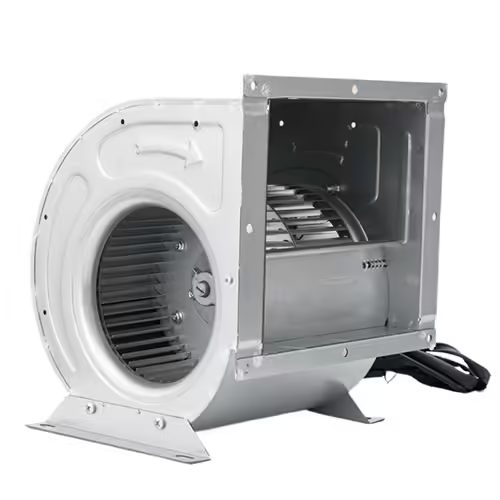
- Smart Monitoring: IoT-enabled sensors detect wear and predict maintenance schedules.
- Eco-Friendly Heavy Duty Designs: Energy-efficient motors, low-noise operation, and recyclable materials.
- Advanced Materials: Use of high-strength alloys and protective coatings to resist extreme conditions.
- Scalable and Modular Systems: Easy integration into large industrial airflow networks for growing operations.
These trends make heavy duty centrifugal blowers a critical component for modern industrial efficiency.
Conclusion
A heavy duty centrifugal blower delivers maximum airflow, long-term reliability, and low-maintenance performance for industrial applications. From mining and steel processing to chemical plants and large HVAC systems, these blowers ensure stable, high-capacity ventilation under the most demanding conditions.
Need help selecting the right heavy duty centrifugal blower for your facility? Contact our experts today for a customized solution that maximizes airflow, reduces downtime, and ensures energy-efficient industrial performance.
FAQ
Q1: What is a heavy duty centrifugal blower?
A: It is a high-performance blower built for continuous, industrial use. Designed with reinforced impellers, robust housings, and durable motors, it delivers stable airflow in demanding environments.
Q2: Which industries benefit most from heavy duty centrifugal blowers?
A: Common applications include chemical plants, mining, steel processing, power generation, and large-scale HVAC systems where high capacity and reliability are essential.
Q3: How does a heavy duty centrifugal blower reduce maintenance downtime?
A: Its modular design allows easy access to bearings, impellers, and motors, enabling faster inspections, servicing, and replacement of parts.
Q4: Can heavy duty centrifugal blowers save energy?
A: Yes. Optimized impellers, efficient motors, and optional variable frequency drives (VFD) reduce electricity usage while maintaining consistent airflow.
Q5: Are heavy duty centrifugal blowers customizable?
A: Absolutely. You can tailor impeller type, housing material, motor power, and mounting style to meet the specific requirements of your industrial or commercial operation.