
Table of Contents
A cabinet type centrifugal fan is a versatile and powerful ventilation solution widely used in industrial and commercial environments. As a manufacturer specializing in these fans, we understand the demands of modern HVAC systems, industrial ventilation, dust collection, and clean room applications. In this guide, we will explain how cabinet type centrifugal fans work, their benefits, how to select the right model, and how to maintain them for long-term reliability. Whether you are an engineer, HVAC contractor, or facility manager, this article will help you make informed decisions.
What Is a Cabinet Type Centrifugal Fan?

A cabinet type centrifugal fan is a type of blower that uses a rotating impeller to move air at high pressure through a cabinet housing. Unlike axial fans that push air in a straight line, centrifugal fans generate airflow by forcing air outward from the center of the impeller into the cabinet and then out through the outlet. This design allows cabinet type fans to handle higher static pressures, making them suitable for ducted systems and long duct runs.
Cabinet type centrifugal fans are commonly used in applications where high pressure and stable airflow are required, such as HVAC units, industrial ventilation, dust collection systems, and clean rooms. The cabinet enclosure also provides additional protection for the internal components, helping to reduce noise and improve safety.
How Cabinet Type Centrifugal Fans Work (Working Principle)
The working principle of a cabinet type centrifugal fan is straightforward yet highly effective. Air enters the fan through the inlet and is captured by the rotating impeller. As the impeller spins, the air is accelerated outward due to centrifugal force. The cabinet then guides the air toward the outlet, converting kinetic energy into pressure energy. This results in a strong, consistent airflow capable of overcoming resistance from ducts, filters, and other system components.
There are two common impeller blade designs:
- Backward-curved blades: These blades offer high efficiency and stable performance. They are often used in HVAC systems where energy efficiency and low noise are critical.
- Forward-curved blades: These blades generate higher airflow at lower pressures, making them suitable for applications requiring large volume but moderate pressure.
The cabinet housing also helps reduce vibration and noise, which is especially important in indoor applications such as commercial buildings, laboratories, and data centers.
Cabinet Type Centrifugal Fan Advantages (Why Choose It)
Cabinet type centrifugal fans are popular for several reasons:
High Static Pressure Performance
They can maintain strong airflow even when the system has high resistance. This makes them ideal for ducted systems, long duct runs, and filtration systems where pressure loss is significant.
Low Noise & Vibration
The enclosed cabinet structure, combined with balanced impeller design, reduces noise levels and vibration. For applications like clean rooms, laboratories, and office buildings, low-noise performance is essential.
Compact Structure & Easy Installation
Cabinet type fans are compact and often come with mounting frames, making installation simpler. They can be integrated into HVAC systems, air handling units (AHUs), and industrial ventilation setups without occupying too much space.
Durable and Reliable
As a manufacturer, we design these fans to withstand demanding environments. With proper material selection—such as galvanized steel, stainless steel, or carbon steel—the fans can resist corrosion, dust, and high temperatures.
Energy Saving
When combined with a variable frequency drive (VFD), cabinet type centrifugal fans can operate at the optimal speed for each application, reducing power consumption and operational costs.
Common Applications of Cabinet Type Centrifugal Fans
Cabinet type centrifugal fans are used across many industries due to their versatility and reliability. Here are some of the most common applications:
HVAC Systems in Commercial Buildings
They are often installed in air handling units and ventilation systems to supply fresh air and maintain indoor air quality.
Industrial Ventilation in Factories and Workshops
These fans provide exhaust and ventilation in manufacturing facilities, ensuring a safe working environment.
Dust Collection & Air Filtration Systems
Cabinet type centrifugal fans are ideal for dust extraction systems, where stable pressure and airflow are needed to move air through filters and ductwork.
Clean Rooms, Laboratories, and Medical Facilities
In controlled environments, these fans help maintain precise airflow, temperature, and humidity levels.
Kitchen Exhaust and Fume Extraction
They can handle grease-laden air and remove fumes efficiently in commercial kitchens and industrial cooking areas.
Data Centers and Server Rooms
High-performance ventilation is essential for cooling and preventing overheating in data centers, making cabinet type fans a suitable choice.
How to Choose the Right Cabinet Type Centrifugal Fan (Selection Guide)
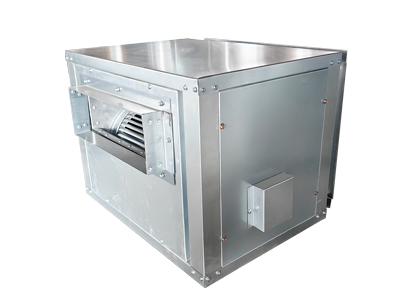
Selecting the correct cabinet type centrifugal fan requires careful consideration of system requirements. Here are the key factors:
Determine Airflow Requirements
The required airflow is usually measured in cubic meters per hour (m³/h) or cubic feet per minute (CFM). You need to calculate the volume of air that must be moved based on the space size, occupancy, and ventilation standards.
Static Pressure and Duct Length
Static pressure is the resistance the fan must overcome. Longer ducts, multiple bends, and filters increase pressure loss. Choose a fan with sufficient static pressure to maintain airflow.
Noise Requirements
If the system is installed indoors or near occupied areas, noise level is a critical factor. Look for low-noise centrifugal fans and consider adding sound attenuators if necessary.
Power Supply and Voltage
Common power options include 220V and 380V, with single-phase or three-phase motors. Confirm the local electrical standards and select a compatible model.
Material and Durability
For corrosive or high-temperature environments, stainless steel or specialized coatings are recommended. For general industrial use, galvanized or carbon steel is often sufficient.
VFD (Variable Frequency Drive) for Energy Saving
A VFD allows speed adjustment based on real-time demand, reducing energy consumption and improving system efficiency.
Impeller Type Selection
Choose between backward-curved and forward-curved impellers based on your required airflow and pressure.
Cabinet Type Centrifugal Fan Performance Parameters You Must Know
Understanding the key parameters will help you choose the right fan and optimize performance.
| Parameter | What It Means | Why It Matters |
|---|---|---|
| Airflow (m³/h or CFM) | Volume of air moved | Determines ventilation capacity |
| Static Pressure (Pa) | Resistance the fan must overcome | Affects ducting and filter performance |
| Efficiency | Ratio of output to input power | Impacts energy cost |
| Noise Level (dB) | Sound produced during operation | Important for indoor environments |
| Motor Power (kW) | Electrical power required | Influences operating cost |
| Protection Level (IP Rating) | Dust and water resistance | Determines suitability for harsh environments |
| Bearing Type | Rolling or sleeve bearings | Affects lifespan and maintenance |
Common Problems and Troubleshooting Tips
Even the best fans can experience issues if not maintained properly. Here are common problems and how to address them:
Fan Not Starting
This is often caused by wiring issues, motor failure, or power supply problems. Check the wiring diagram, ensure the correct voltage, and inspect the motor for signs of damage.
Loud Noise
Noise can be caused by bearing wear, imbalance, or dust accumulation. Inspect the bearings, clean the fan, and balance the impeller if needed.
Low Airflow
Low airflow is usually due to clogged filters, duct leakage, or improper fan selection. Clean or replace filters, seal duct connections, and verify that the fan meets the required airflow and pressure.
Overheating
Overheating may indicate motor overload, poor ventilation, or a blocked inlet. Ensure proper ventilation, reduce load, and inspect the motor for faults.
Vibration Issues
Vibration can damage the fan and reduce efficiency. Check mounting stability, inspect the impeller balance, and ensure bearings are in good condition.
Maintenance & Installation Best Practices
Proper installation and maintenance are key to long-term performance and reliability.
Installation Tips
- Install the fan on a stable and vibration-free base
- Ensure proper inlet and outlet clearance
- Avoid sharp bends near the fan inlet
- Use flexible connectors to reduce vibration transfer
Routine Inspection Checklist
- Check motor and bearing temperature
- Inspect belts and pulleys (if applicable)
- Clean dust and debris from the cabinet
- Verify electrical connections and insulation
- Measure airflow and pressure regularly
Cleaning and Dust Removal
Regular cleaning helps maintain airflow and prevents clogging. For dust collection systems, clean filters and ductwork frequently.
Lubrication and Bearing Replacement
Proper lubrication extends bearing life. Replace bearings when wear is detected to prevent sudden failures.
Why Choose Us as Your Cabinet Type Centrifugal Fan Manufacturer

As a manufacturer, we provide complete solutions for cabinet type centrifugal fans. Our strengths include:
- In-house production and strict quality control
- Custom design and OEM/ODM services
- High-performance motors and balanced impellers
- Wide range of materials: stainless steel, galvanized steel, carbon steel
- Certifications and compliance with industry standards
- Professional after-sales support and technical assistance
We also offer customized solutions for specific industries, such as clean rooms, HVAC systems, industrial ventilation, and dust collection. Our team can help you choose the right fan model based on your requirements and provide detailed performance data and installation guidance.
Conclusion
Cabinet type centrifugal fans are a reliable and efficient solution for a wide range of applications, including HVAC systems, industrial ventilation, dust collection, and clean rooms. As a manufacturer, we design and produce high-quality fans that offer strong static pressure, low noise, and long service life. By selecting the right model and maintaining it properly, you can ensure stable performance and reduce operating costs. If you need a customized solution or technical support, feel free to contact us for more details on our cabinet type centrifugal fan products, high-pressure centrifugal fans, and industrial ventilation systems.
FAQ
What is the difference between a cabinet type centrifugal fan and an axial fan?
Cabinet type centrifugal fans generate higher static pressure and are better for ducted systems, while axial fans are suited for large volume, low-pressure applications.
How do I select the right cabinet type centrifugal fan for HVAC?
Calculate required airflow and static pressure, then choose a fan with suitable performance and efficiency. Consider noise level and power supply.
Can cabinet type centrifugal fans be used for dust collection?
Yes, they are ideal for dust extraction systems due to their strong pressure performance and stable airflow.
What is the typical lifespan of a cabinet type centrifugal fan?
With proper maintenance, these fans can operate reliably for many years. Lifespan depends on operating conditions and maintenance practices.
How often should I maintain the fan?
Routine checks are recommended every 3–6 months, with more frequent cleaning in dusty environments.
How to reduce noise in cabinet type centrifugal fans?
Use a low-noise model, install vibration isolators, and ensure proper balancing of the impeller.