
Table of Contents
Introduction
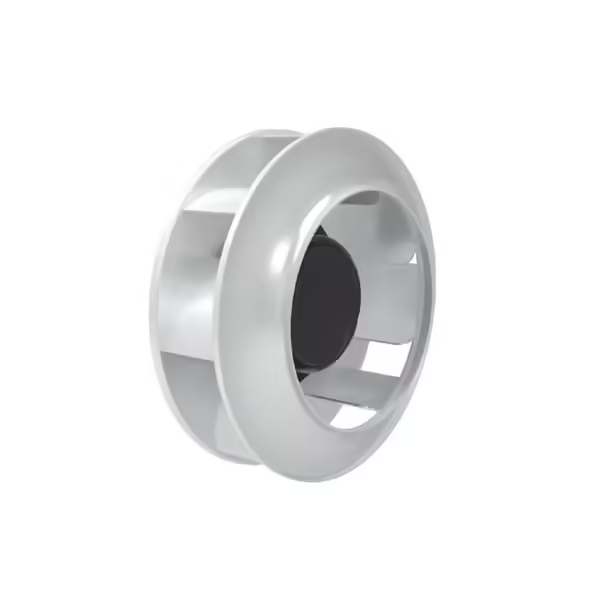
When efficiency and energy savings are priorities in industrial or commercial ventilation, a backward-curved centrifugal fan often provides the optimal solution. Unlike forward-curved or radial fans, backward-curved fans are designed for high efficiency, low noise, and consistent performance, making them ideal for a variety of high-demand airflow applications.
These fans are widely used in HVAC systems, factories, data centers, and cleanrooms where reliable, energy-efficient airflow is critical.
How Backward-Curved Centrifugal Fans Work
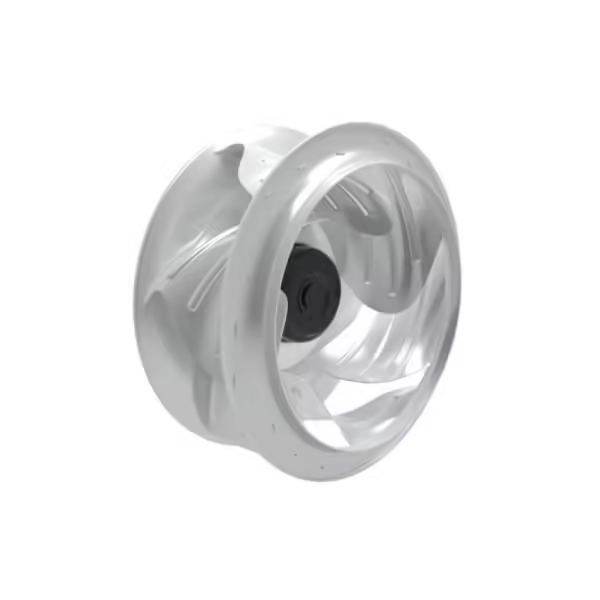
Backward-curved centrifugal fans operate using blades that curve away from the direction of rotation. This design:
- Reduces turbulence – Produces smoother airflow, minimizing energy loss.
- Increases efficiency – Converts motor power into airflow more effectively.
- Maintains consistent pressure – Ideal for ducted systems with variable resistance.
- Reduces Noise – Backward-curved blades produce quieter operation than forward-curved fans.
This combination of efficiency and low noise makes them a preferred choice for many industrial and commercial applications.
Key Features of Backward-Curved Centrifugal Fans
- High Efficiency – Less energy is wasted, resulting in lower operating costs.
- Durable Blades – Can handle particulate-laden air and continuous operation.
- Low Noise – Smooth airflow reduces operational noise.
- Stable Performance – Maintains airflow and pressure across varying system loads.
- Flexible Configurations – Can be floor-mounted, inline, or duct-mounted.
- Customizable Options – Blade design, impeller size, and motor power can be tailored.
- Energy-Saving Designs – Ideal for long-term operation in high-demand systems.
Types of Backward-Curved Centrifugal Fans
Standard Backward-Curved Fans
Suitable for general HVAC applications and medium-duty industrial ventilation.
Heavy-Duty Backward-Curved Fans
Designed for high-pressure, high-volume industrial environments with continuous operation.
High-Temperature Backward-Curved Fans
Engineered to operate in elevated temperature conditions without efficiency loss.
Inline Backward-Curved Fans
Compact design for ducted systems that require high efficiency and low noise.
Comparison Table: Forward-Curved vs Backward-Curved Fans
| Feature | Forward-Curved Fan | Backward-Curved Fan |
|---|---|---|
| Efficiency | Moderate | High |
| Noise Level (dB) | Moderate-High | Low |
| Suitable Pressure Range | Low-Medium | Medium-High |
| Durability | Standard | High |
| Best Use Case | Residential, light HVAC | Industrial, commercial, high-efficiency HVAC |
Applications of Backward-Curved Centrifugal Fans
Backward-curved fans are suitable for a wide range of scenarios:
- Commercial HVAC Systems – Offices, shopping malls, hotels, and hospitals.
- Industrial Ventilation – Factories, processing plants, and workshops.
- Data Centers – Efficient cooling with low noise for server rooms.
- Cleanrooms & Laboratories – Precise, stable airflow for sensitive environments.
- Dust and Fume Extraction – Maintain pressure and airflow while handling particulates.
- Agricultural Ventilation – Consistent airflow for barns, greenhouses, and storage facilities.
Selecting the Right Backward-Curved Fan
Key considerations when choosing a backward-curved centrifugal fan:
- Airflow Requirements (CFM) – Ensure fan meets system airflow demand.
- Static Pressure (Pa) – Match fan to duct resistance and filtration systems.
- Motor Efficiency – Select energy-efficient motors suitable for continuous operation.
- Noise Requirements – Backward-curved fans are quieter, but consider acoustic needs.
- Material Durability – Resistant to corrosion, particulates, or high temperature.
- Installation Space – Determine if floor-mounted, inline, or duct-mounted is best.
- Maintenance Access – Plan for easy inspection and servicing.
Maintenance Tips for Backward-Curved Fans
- Inspect impellers for wear, particulates, or corrosion regularly.
- Lubricate bearings according to manufacturer recommendations.
- Monitor vibration and noise for early signs of imbalance.
- Keep ductwork and filters clean to maintain airflow efficiency.
- Schedule preventive maintenance for long-term reliable operation.
Benefits of Working with a Manufacturer
Partnering with an experienced fan manufacturer ensures:
- Fans are engineered for optimal efficiency, durability, and low noise.
- Expert guidance on blade design, motor selection, and system integration.
- High-quality components for long-term energy savings.
- Support for installation, preventive maintenance, and troubleshooting.
Conclusion
A backward-curved centrifugal fan is a high-efficiency, low-noise solution for industrial and commercial ventilation. By selecting the appropriate fan, installing it properly, and performing routine maintenance, users can achieve energy savings, reliable airflow, and long-term durability. Backward-curved fans are particularly well-suited for applications requiring high efficiency, stable airflow, and quiet operation.
FAQ
Q1: What is a backward-curved centrifugal fan?
A: A fan with blades curving away from the rotation direction, designed for high efficiency, low noise, and stable airflow.
Q2: Where are backward-curved fans commonly used?
A: Industrial facilities, commercial HVAC, data centers, cleanrooms, and dust/fume extraction systems.
Q3: How do I select the right backward-curved fan?
A: Consider airflow, static pressure, motor efficiency, noise levels, materials, and installation space.
Q4: Are backward-curved fans energy-efficient?
A: Yes, their blade design converts motor power into airflow more efficiently, reducing energy costs.
Q5: How should I maintain a backward-curved fan?
A: Regular inspections, cleaning, bearing lubrication, and preventive maintenance are recommended.