
Table of Contents
Introduction
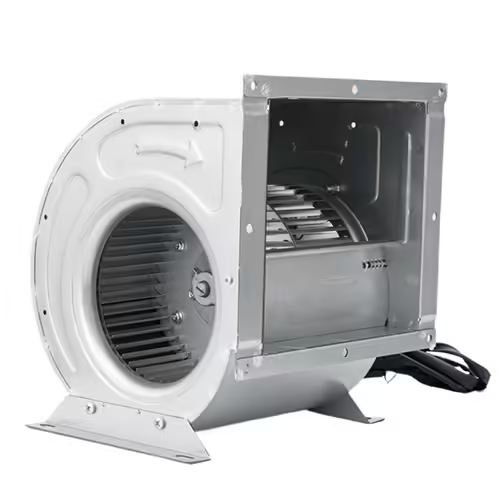
In industrial and commercial ventilation systems where rapid airflow is essential, a high-speed centrifugal fan offers unmatched performance. These fans are engineered to deliver high velocity airflow with precision, making them ideal for processes requiring quick air movement, high pressure, and compact installation.
High-speed centrifugal fans are commonly used in power plants, manufacturing facilities, data centers, chemical processing, and HVAC systems that demand fast, reliable airflow.
How High-Speed Centrifugal Fans Work
High-speed centrifugal fans operate on the centrifugal principle but with enhancements for high rotational speed:
- Precision-Balanced Impellers – Minimize vibration at high RPMs.
- High-Torque Motors – Provide the power necessary to maintain velocity.
- Aerodynamically Optimized Blades – Reduce turbulence and maximize efficiency.
- Durable Bearings and Shafts – Designed to withstand continuous high-speed operation.
These design elements allow the fan to achieve higher pressure and faster airflow than standard centrifugal fans while maintaining stability and safety.
Key Performance Advantages
- High Air Velocity – Rapid airflow suitable for industrial ventilation and cooling.
- Stable Pressure – Maintains consistent performance in ducted or open systems.
- Compact Design – High-speed operation allows smaller fan size for equivalent airflow.
- Energy Efficiency – Optimized impellers and motors reduce energy consumption.
- Low Vibration and Noise – Precision engineering minimizes operational disturbances.
- Extended Service Life – High-quality components designed for continuous, demanding operation.
Applications of High-Speed Centrifugal Fans
High-speed centrifugal fans are ideal for demanding environments:
- Industrial Manufacturing – Ventilation of machinery, furnaces, and processing lines.
- Power Plants – High-velocity airflow for cooling and ventilation.
- Data Centers – Rapid cooling of high-density server racks.
- Chemical Processing – Efficient extraction of fumes, heat, and particles.
- HVAC Systems – Quick air distribution in large commercial buildings.
- Cleanrooms and Laboratories – Fast, precise airflow control for critical environments.
Performance Comparison: High-Speed vs Standard Centrifugal Fans
| Feature | Standard Fan | High-Speed Centrifugal Fan |
|---|---|---|
| Air Velocity | Moderate | High |
| Static Pressure | Low-Medium | Medium-High |
| Motor RPM | Standard | High |
| Noise Level | Moderate | Moderate-Low (optimized) |
| Suitable Applications | General ventilation | Industrial, data centers, HVAC, chemical plants |
How to Choose the Right High-Speed Centrifugal Fan
- Airflow and Velocity Requirements (CFM) – Ensure the fan meets process or system demand.
- Static Pressure (Pa) – Check fan’s capacity to overcome duct or system resistance.
- Motor Type and Speed Rating – High-speed motors should match RPM requirements.
- Material Durability – Choose heat-resistant, corrosion-resistant materials if needed.
- Noise Considerations – Consider blade design or acoustic housing to reduce noise.
- Installation Space – High-speed fans allow smaller footprints but require secure mounting.
- Maintenance Accessibility – Plan for inspection, balancing, and lubrication intervals.
Maintenance Tips for High-Speed Fans
- Regularly inspect impellers for wear, cracks, or imbalance.
- Check bearings and lubrication levels; high RPM operation accelerates wear.
- Monitor vibration and noise levels to detect early issues.
- Clean ducts, filters, and housings to prevent airflow obstruction.
- Follow manufacturer-recommended preventive maintenance schedules.
Case Studies and Applications
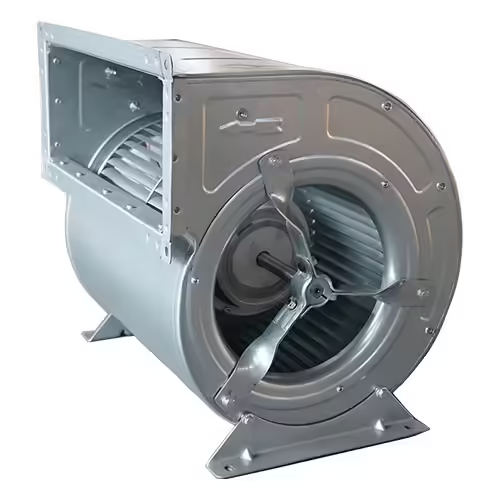
- Data Center Cooling: High-speed fans maintain optimal server temperatures, reducing the risk of overheating and downtime.
- Industrial Oven Ventilation: Rapid airflow ensures even temperature distribution and improved production efficiency.
- Chemical Plant Exhaust Systems: Quickly removes fumes and particulates, ensuring worker safety and process efficiency.
FAQ
Q1: What is a high-speed centrifugal fan?
A: A fan designed to operate at high rotational speeds, delivering fast, precise airflow for industrial and commercial applications.
Q2: Where are high-speed centrifugal fans used?
A: Power plants, manufacturing facilities, data centers, chemical plants, HVAC systems, and cleanrooms.
Q3: How do I select the right high-speed fan?
A: Consider airflow, static pressure, motor speed, material durability, noise, and installation space.
Q4: Are high-speed fans energy-efficient?
A: Yes, aerodynamic blade design and high-speed motors maximize airflow per unit of power.
Q5: How should I maintain a high-speed fan?
A: Inspect impellers, lubricate bearings, monitor vibration, clean ducts, and follow preventive maintenance schedules.
Conclusion
A high-speed centrifugal fan is essential for applications requiring rapid airflow, consistent pressure, and compact installation. By selecting the appropriate fan, installing it properly, and maintaining it regularly, operators can achieve high efficiency, reliable performance, and long-term durability. High-speed fans are perfect for industrial, commercial, and specialized environments where speed and precision are critical.