
Table of Contents
Introduction
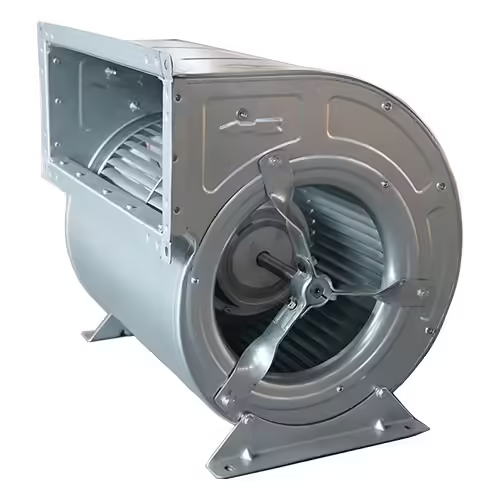
When efficient airflow is a top priority, a high-flow centrifugal fan becomes an essential solution. These fans are engineered to deliver large volumes of air at consistent pressure, making them ideal for factories, warehouses, HVAC systems, data centers, and commercial buildings.
High-flow centrifugal fans combine aerodynamic impellers, optimized housing, and precision motors to maintain maximum airflow without compromising performance or reliability. Using these fans ensures effective ventilation, temperature control, and air quality in demanding environments.
How High-Flow Centrifugal Fans Work
High-flow centrifugal fans function similarly to standard centrifugal fans but are optimized for large air volumes:
- Wide-Angle Impellers – Maximize airflow while reducing turbulence.
- Aerodynamic Housing – Directs air efficiently, maintaining consistent pressure.
- High-Performance Motors – Deliver continuous power to sustain high airflow.
- Balanced Air Distribution – Prevents vibration, noise, and energy loss.
This combination allows high-flow fans to handle demanding applications while remaining energy-efficient and reliable.
Key Features of High-Flow Centrifugal Fans
High-flow centrifugal fans stand out due to:
- Maximum Air Volume Delivery – Capable of moving large quantities of air efficiently.
- Durable Construction – Built to withstand heavy-duty operation and long working hours.
- Flexible Design Options – Available in forward, backward, radial, and inline configurations.
- Low Maintenance Requirements – Precision engineering reduces wear and downtime.
- Customizable Airflow and Pressure – Fans can be tailored for specific system needs.
Types of High-Flow Centrifugal Fans
Forward Curved High-Flow Fans
Ideal for low-pressure, high-volume airflow in commercial ventilation systems.
Backward Curved High-Flow Fans
Provide higher efficiency and energy savings in large-scale industrial applications.
Radial High-Flow Fans
Handle dusty or particulate-laden air while maintaining airflow efficiency.
Inline High-Flow Fans
Compact and suitable for ducted systems requiring significant air volume without occupying floor space.
Comparison Table: High-Flow vs Standard Centrifugal Fans
| Feature | Standard Fan | High-Flow Centrifugal Fan |
|---|---|---|
| Maximum Airflow (CFM) | 500–2000 | 2000–10000+ |
| Static Pressure | Low | Medium–High |
| Noise Level (dB) | 70–85 | 60–75 |
| Maintenance Frequency | Medium | Low–Medium |
| Best Use Case | Light-duty | Large-scale Ventilation |
Applications of High-Flow Centrifugal Fans
High-flow centrifugal fans are suitable for diverse environments:
- Industrial Factories – Provide ventilation in large halls or production lines.
- Warehouses – Maintain airflow for temperature and air quality control.
- HVAC Systems – Deliver high-volume air to multiple zones efficiently.
- Data Centers – Cool servers with consistent, high-volume airflow.
- Commercial Kitchens – Remove smoke, heat, and odors effectively.
- Agricultural Facilities – Ventilate barns, greenhouses, and processing plants.
- Mining and Material Handling – Handle large air volumes for dust extraction and ventilation.
Selecting the Right High-Flow Centrifugal Fan
When choosing a high-flow fan, consider:
- Required Airflow (CFM) – Ensure the fan meets the volume needs of the space.
- Static Pressure Requirements – Match fan pressure to system resistance.
- Installation Space – High-flow fans may require larger housings or ducts.
- Material Durability – Choose corrosion-resistant metals for longevity.
- Energy Efficiency – Higher airflow usually means higher energy use; optimize fan selection.
- Noise Control – Some high-flow fans incorporate noise-reducing features for sensitive environments.
Maintenance Tips for High-Flow Fans
Even high-quality fans need proper care to maintain performance:
- Clean impellers, ducts, and housings regularly to avoid airflow loss.
- Inspect and lubricate bearings and motors as needed.
- Check for vibration or unusual noise that may indicate imbalance.
- Replace worn components promptly to avoid larger system issues.
- Schedule preventive maintenance for maximum efficiency and fan lifespan.
Benefits of Working with a Reliable Manufacturer
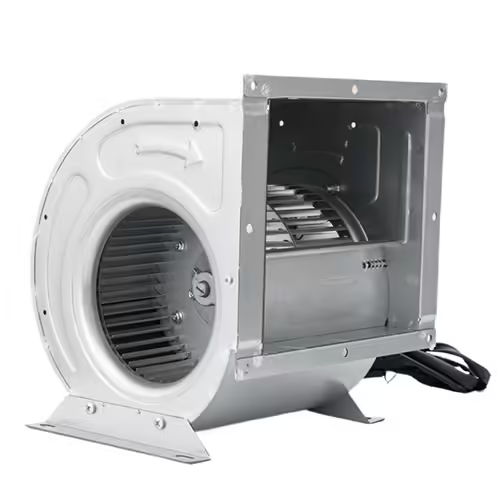
Partnering with a trusted manufacturer ensures:
- Fans engineered for long-term, high-volume performance.
- Custom solutions for airflow, pressure, and installation constraints.
- High-quality materials and precision engineering for durability.
- Expert support in installation, maintenance, and troubleshooting.
Conclusion
A high-flow centrifugal fan is the ideal solution for environments requiring large-volume airflow. By selecting the right fan, ensuring proper installation, and performing regular maintenance, facilities can achieve reliable ventilation, improved air quality, and operational efficiency. High-flow fans are essential for industrial, commercial, and large-scale applications where consistent, high-volume airflow is critical.
FAQ
Q1: What is a high-flow centrifugal fan?
A: A fan designed to move large volumes of air efficiently while maintaining consistent static pressure.
Q2: Where are high-flow fans typically used?
A: Factories, warehouses, HVAC systems, data centers, commercial kitchens, agricultural and mining facilities.
Q3: How do I choose the right high-flow fan?
A: Consider airflow (CFM), static pressure, system resistance, material durability, and installation space.
Q4: Can high-flow fans operate continuously?
A: Yes, they are designed for continuous operation under demanding conditions.
Q5: How should I maintain a high-flow centrifugal fan?
A: Regular cleaning, lubrication, vibration inspection, and preventive maintenance ensure optimal airflow and longevity.