
Table of Contents
Introduction
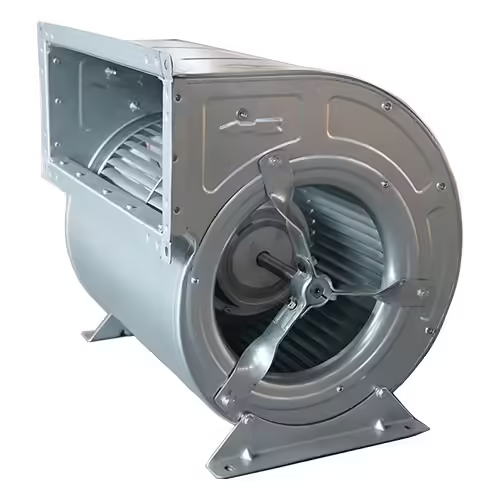
In modern industrial facilities, ventilation systems often require fans that are tailored to specific operational demands. Custom industrial centrifugal fan solutions are designed to meet these unique requirements, offering optimized airflow, precise static pressure, and energy-efficient performance.
Unlike standard off-the-shelf fans, custom fans can be engineered for high-temperature environments, corrosive gases, heavy particulate loads, or unique ductwork layouts. By partnering directly with a manufacturer, factories gain access to fans that deliver reliable operation and long-term durability.
Why Choose Custom Centrifugal Fan Solutions
Standard centrifugal fans may not always fit specialized industrial environments. Custom solutions allow manufacturers to address:
- Unique airflow requirements – Factories may need precise CFM and pressure to maintain system efficiency.
- Special environmental conditions – Fans can be made from stainless steel, coated alloys, or other materials resistant to heat, chemicals, or moisture.
- Space and installation constraints – Custom fan housings and impellers fit into compact or complex layouts.
- Noise and energy optimization – Tailored designs can reduce operational noise and increase efficiency.
By selecting a custom solution, factories avoid overworking standard fans, reduce energy costs, and improve system reliability.
Types of Custom Industrial Centrifugal Fans
Custom centrifugal fans can be engineered in various configurations:
- Forward Curved Custom Fans – Efficient for low-pressure ventilation systems.
- Backward Curved Custom Fans – High efficiency and low energy consumption for high-pressure systems.
- Radial and High-Pressure Custom Fans – Designed to handle dust, particulates, and high-resistance ducting.
- Double Inlet or Multi-Inlet Fans – Provide large airflow volumes for expansive industrial systems.
Each type can be adjusted for impeller diameter, blade design, and motor selection to perfectly match factory requirements.
Key Considerations for Custom Fan Design
When designing a custom industrial centrifugal fan, several critical factors must be addressed:
- Airflow (CFM) and Static Pressure – Accurate calculation ensures efficiency and avoids overloading.
- Material Selection – Stainless steel, galvanized steel, or coated alloys protect against corrosion and wear.
- Motor and Drive Options – High-efficiency motors and variable speed drives (VSD) optimize energy consumption.
- Noise Control – Custom housing and blade profiles reduce noise for indoor industrial applications.
- Maintenance Access – Designs should allow easy inspection, lubrication, and cleaning.
Applications of Custom Centrifugal Fans
Custom industrial fans are widely used in sectors where standard fans are insufficient:
- Chemical and pharmaceutical factories – Resistant to corrosive gases and precise airflow control.
- Food and beverage processing – Sanitary designs for hygiene and controlled ventilation.
- Dust collection and air filtration – High-efficiency designs for cement, steel, or mining operations.
- HVAC and large warehouse ventilation – Energy-efficient solutions for large airflow requirements.
- Boilers and high-temperature systems – Fans engineered to withstand extreme heat and pressure.
Custom Fan Application Table
| Fan Type | Factory Application | Custom Feature | Efficiency |
|---|---|---|---|
| Forward Curved | HVAC Systems | Compact housing | Medium |
| Backward Curved High-Efficiency | Dust Collection | High static pressure | High |
| Radial High-Pressure | Cement, Mining | Heavy particulate handling | High |
| Multi-Inlet Custom Fan | Large Industrial Ventilation | Multiple airflow inlets | Very High |
Maintenance Tips for Custom Fans
Even with custom designs, proper maintenance is essential:
- Lubricate bearings and check motor health regularly.
- Clean impellers, housings, and ducts to maintain airflow.
- Inspect alignment and fasteners for secure operation.
- Implement a preventive maintenance schedule to ensure long-term reliability.
Regular maintenance maximizes efficiency, prevents downtime, and extends fan lifespan.
Benefits of Working with a Manufacturer
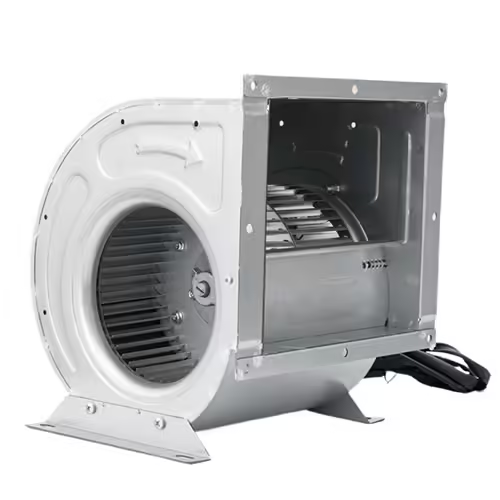
As a manufacturer of custom industrial centrifugal fans, we provide:
- Tailored solutions for unique factory needs.
- Direct consultation to optimize airflow, pressure, and efficiency.
- Strict quality control and testing for consistent performance.
- Support for OEM and special industrial applications.
By working directly with a manufacturer, factories gain high-performing fans that meet both operational and energy-saving goals.
Conclusion
Custom industrial centrifugal fan solutions are the ideal choice for factories with specific ventilation challenges. By designing fans to meet unique airflow, static pressure, material, and spatial requirements, industrial facilities can achieve reliable, efficient, and long-lasting ventilation. Partnering with a trusted manufacturer ensures that these solutions provide optimal performance while minimizing energy consumption and maintenance needs.
FAQ
Q1: What are custom industrial centrifugal fan solutions?
A: They are tailored fans designed to meet unique factory ventilation requirements, including specific airflow, static pressure, and material needs.
Q2: Why choose a custom centrifugal fan over a standard fan?
A: Custom fans provide optimized performance for unique factory layouts, high-resistance ductwork, corrosive environments, or high-temperature applications.
Q3: How do I determine the right custom fan for my factory?
A: Consider airflow (CFM), static pressure, energy efficiency, material durability, noise level, and installation constraints. Consulting a manufacturer ensures optimal selection.
Q4: What industries use custom centrifugal fan solutions?
A: Common industries include chemical, pharmaceutical, food processing, dust collection, HVAC, cement, and steel production facilities.
Q5: How should I maintain a custom industrial centrifugal fan?
A: Regular maintenance includes lubricating bearings, cleaning impellers and ducts, inspecting alignment, and following a preventive schedule to maximize efficiency and lifespan.