
Table of Contents
What Is a Low Noise Centrifugal Blower?
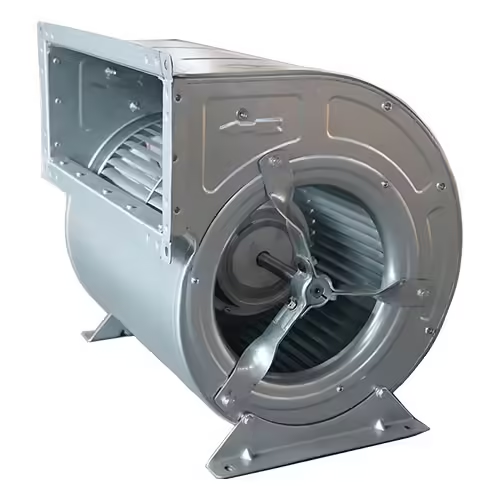
A low noise centrifugal blower is designed to provide efficient airflow and high static pressure while operating at reduced sound levels. By optimizing impeller design, motor selection, and housing structure, these blowers can significantly reduce operational noise without sacrificing performance.
Low noise centrifugal blowers are widely used in environments where quiet operation is critical, such as laboratories, offices, cleanrooms, and commercial buildings, while still meeting industrial ventilation demands.
Why Low Noise Operation Matters
Excessive noise from ventilation and blower systems can:
- Affect worker productivity and comfort
- Violate noise regulations in industrial and commercial settings
- Cause stress or hearing issues in sensitive environments
Low noise centrifugal blowers address these concerns by:
- Minimizing turbulence with backward-curved or radial impellers
- Reducing vibration through precision balancing
- Optimizing housing and duct design to lower sound levels
Example: Facilities that switched from standard blowers to low noise models reported noise reductions of 5–10 dB, significantly improving the working environment.
Key Features of Low Noise Centrifugal Blowers
To achieve quiet performance, these blowers typically include:
- Optimized Impellers: Minimize air turbulence and reduce aerodynamic noise.
- High-Quality Motors: Smooth operation with minimal vibration.
- Acoustic Housing Design: Enclosures that dampen sound transmission.
- Precision Balancing and Bearings: Reduce mechanical noise and extend lifespan.
- Durable Materials: Suitable for industrial, commercial, or laboratory environments.
These features ensure a blower that is both quiet and reliable, ideal for noise-sensitive areas.
Applications for Low Noise Centrifugal Blowers
Low noise centrifugal blowers are used in various settings:
- Laboratories and Cleanrooms – Maintain precise airflow without disturbing sensitive equipment or processes.
- Commercial Buildings and Offices – Provide comfortable ventilation without disrupting occupants.
- HVAC Systems – Reduce noise in heating, cooling, and air handling units.
- Industrial Processes in Noise-Sensitive Areas – Factories where workers operate near ventilation equipment.
- Medical and Pharmaceutical Facilities – Quietly remove air, fumes, or contaminants while maintaining regulatory compliance.
Data Point: Noise-sensitive facilities replacing standard centrifugal blowers with low noise models observed up to 30% reduction in perceived sound levels, enhancing employee comfort.
How to Choose the Right Low Noise Centrifugal Blower
When selecting a low noise centrifugal blower, consider:
- Airflow (CFM / m³/h) – Ensure it meets ventilation requirements.
- Static Pressure (Pa) – Needed to overcome ducts, filters, and vents.
- Noise Level (dB) – Verify manufacturer specifications for quiet operation.
- Operating Environment – Temperature, dust, moisture, or chemical exposure.
- Motor Type and Efficiency – Smooth operation with low energy consumption.
- Maintenance Requirements – Precision bearings and materials reduce downtime.
Choosing the right model ensures quiet performance, energy efficiency, and long-term reliability.
Low Noise Centrifugal Blower vs Standard Blowers
| Feature | Standard Blower | Low Noise Centrifugal Blower |
|---|---|---|
| Noise Level | Medium-High | Low |
| Airflow Efficiency | Moderate | High |
| Vibration | Moderate | Low |
| Energy Consumption | Standard | Optimized |
| Lifespan | Moderate | Extended due to reduced mechanical stress |
This shows why low noise centrifugal blowers are preferred in noise-sensitive industrial and commercial environments.
Manufacturing Expertise and Custom Options
As a professional manufacturer, we provide low noise centrifugal blowers with:
- Customizable airflow, pressure, and noise levels
- OEM and bulk supply options
- High-quality materials and precision engineering for quiet, reliable operation
- Technical support for system integration and installation
Our solutions ensure quiet, efficient, and durable airflow systems, suitable for sensitive applications.
Conclusion
Low noise centrifugal blowers combine quiet operation with high performance, making them ideal for industrial, commercial, and specialized applications. With optimized design, durable materials, and precision engineering, these blowers reduce noise while maintaining consistent airflow.
Need help selecting the right low noise centrifugal blower for your system? Contact us today for expert guidance and a custom solution that ensures efficient, quiet, and reliable ventilation.
FAQ
Q1: What is a low noise centrifugal blower?
A: It is a centrifugal blower designed to deliver strong airflow and pressure while operating at reduced sound levels, ideal for noise-sensitive industrial and commercial environments.
Q2: What are the main applications of low noise centrifugal blowers?
A: Common applications include laboratories, cleanrooms, offices, HVAC systems, medical facilities, and noise-sensitive industrial processes.
Q3: How does a low noise centrifugal blower differ from a standard blower?
A: It uses optimized impeller designs, precision-balanced motors, and acoustic housings to minimize noise while maintaining airflow and performance.
Q4: What factors should I consider when choosing a low noise centrifugal blower?
A: Important factors include airflow (CFM), static pressure (Pa), noise level (dB), motor efficiency, operating environment, and maintenance requirements.
Q5: Can low noise centrifugal blowers be customized?
A: Yes. Manufacturers can provide custom airflow, pressure, motor options, and acoustic enhancements to meet specific industrial or commercial requirements.